QUESTION 1
v
Easy
Draw the graphs of the following sets of lines. In each case, reflect on the role of 'a' and 'b'.
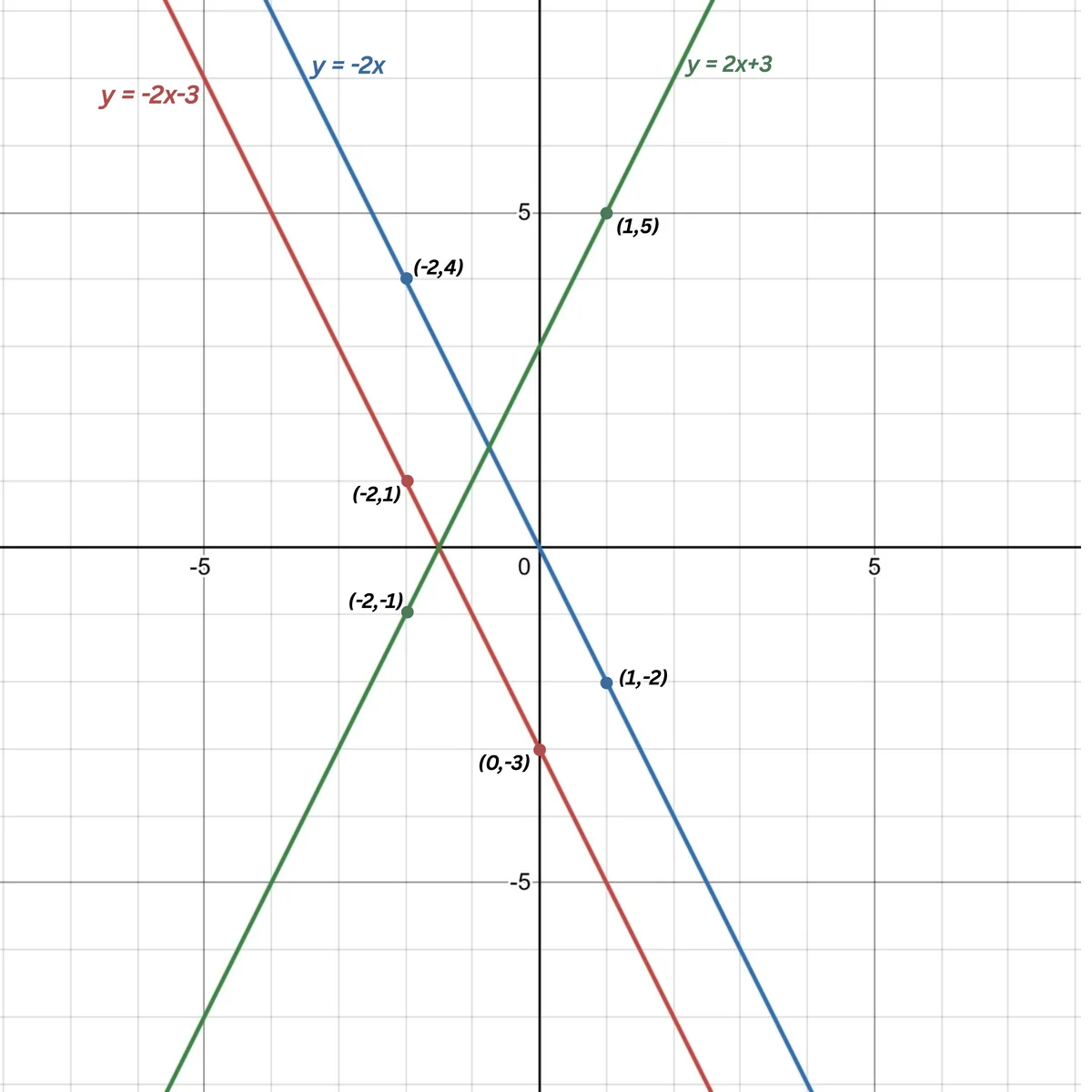
y = −2x − 3, y = −2x, y = 2x + 3
SOLUTION
1
Recall equation of a straight line
A straight line is written in the form \(y = ax + b\), where \(a\) is its slope and \(b\) is the \(y\)- intercept.
2
Identify two points on each line
For \(y = −2x−3\):
When \(x = 0, y = −3\)
When \(x = −2, y = 1\)
So the two points are (\(0,−3\)) and (\(−2,1\))
For \(y = −2x\):
When \(x = 1, y = −2\)
When \(x = −2, y = 4\)
So the two points are (\(1,−2\)) and (\(−2,4\))
For \(y = 2x + 3\):
When \(x = 1, y = 5\)
When \(x = −2, y = −1\)
So the two points are (\(1,5\)) and (\(−2,−1\))
When \(x = 0, y = −3\)
When \(x = −2, y = 1\)
So the two points are (\(0,−3\)) and (\(−2,1\))
For \(y = −2x\):
When \(x = 1, y = −2\)
When \(x = −2, y = 4\)
So the two points are (\(1,−2\)) and (\(−2,4\))
For \(y = 2x + 3\):
When \(x = 1, y = 5\)
When \(x = −2, y = −1\)
So the two points are (\(1,5\)) and (\(−2,−1\))
3
Observe the role of '\(a\)' and '\(b\)'
The first two lines have negative slope \(a = −2\), steep downward and are parallel to each other, while the third line has positive slope(2) and steeps upward.
In line \(y = −2x, b = 0\), so it passes through the (\(0,0\)).
In line \(y = −2x − 3, b = −3\), so the line shifts downward vertically by 3 units and passes through (\(0,−3\)).
In line \(y = 2x + 3, b = 3\), so the line shifts upward vertically by 3 units and passes through (\(0,3\)).
In line \(y = −2x, b = 0\), so it passes through the (\(0,0\)).
In line \(y = −2x − 3, b = −3\), so the line shifts downward vertically by 3 units and passes through (\(0,−3\)).
In line \(y = 2x + 3, b = 3\), so the line shifts upward vertically by 3 units and passes through (\(0,3\)).
Concept Note
When slope \(a > 1\), the line is steeper than the line \(y = x\), which is equally inclined to both axes. However, when \(a < 1\), the line is less steep than the line \(y = x\).
Changing \(b\) shifts the line vertically without changing slope.