QUESTION 10
Easy
The graph of a linear polynomial \(p(x)\) passes through the points (1,5) and (3,11).
i) Find the polynomial p(x).
ii) Find the coordinates where the graph of p(x) cuts the axes.
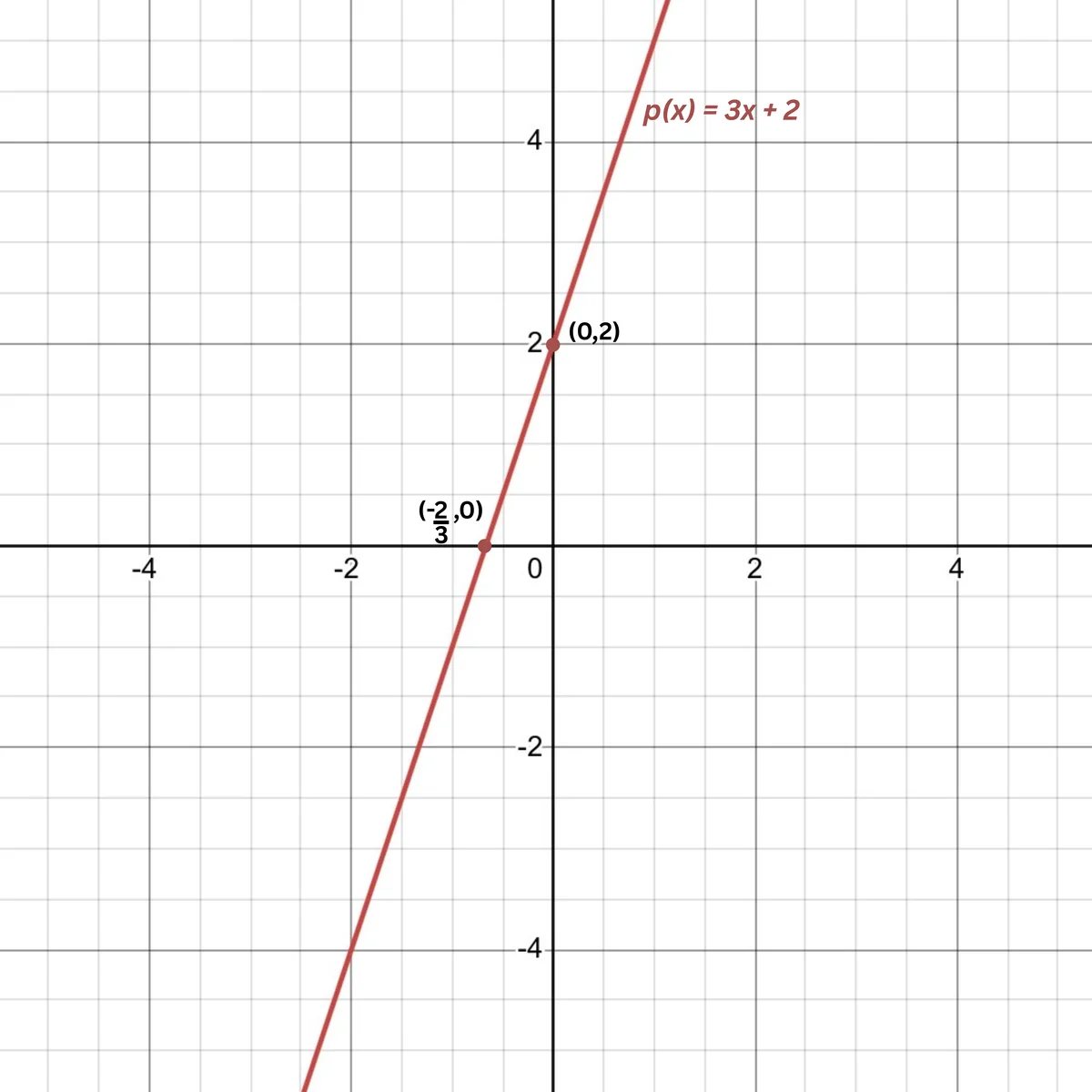
iii) Draw the graph of p(x) and verify your answers.
SOLUTION
1
Find \(p(x)\) using the given points
Since \(p(x)\) is linear, we can write \(p(x) = ax + b\), with constants \(a\) and \(b\).
\(p(x)\) passes through the points \((1,5)\) and \((3,11)\).
So,
\(p(1) = 5\) ⇒ \(a(1) + b = 5\) ⇒ \(a + b = 5\) --- (I)
\(p(3) = 11\) ⇒ \(a(3) + b = 11\) ⇒ \(3a + b = 11\) ---(II)
Subtracting (I) from (II), we get
\((3a + b) − (a + b) = 11 − 5 \)
⇒ \(3a − a + b − b) = 6 \)
⇒ \(2a = 6 \)
⇒ \(a = 3 \)
Substituting this into equation (I), we get
\(3 + b = 5\) ⇒ \(b = 2\)
Thus \(p(x) = 3x + 2\)
\(p(x)\) passes through the points \((1,5)\) and \((3,11)\).
So,
\(p(1) = 5\) ⇒ \(a(1) + b = 5\) ⇒ \(a + b = 5\) --- (I)
\(p(3) = 11\) ⇒ \(a(3) + b = 11\) ⇒ \(3a + b = 11\) ---(II)
Subtracting (I) from (II), we get
\((3a + b) − (a + b) = 11 − 5 \)
⇒ \(3a − a + b − b) = 6 \)
⇒ \(2a = 6 \)
⇒ \(a = 3 \)
Substituting this into equation (I), we get
\(3 + b = 5\) ⇒ \(b = 2\)
Thus \(p(x) = 3x + 2\)
2
Find the coordinates where the graph of \(p(x)\) cuts the axes
For \(y-\) intercept, set \(x = 0\) ⇒ \(p(0) = 3(0) + 2 = 2\)
The line cuts the \(y-\) axis at \((0,2)\)
For \(x-\) intercept, set \(p(x) = 0\) ⇒ \( 3x + 2 = 0\) ⇒ \( x = \frac{−2}{3} \)
The line cuts the \(x-\) axis at \((\frac{−2}{3},0)\)
The line cuts the \(y-\) axis at \((0,2)\)
For \(x-\) intercept, set \(p(x) = 0\) ⇒ \( 3x + 2 = 0\) ⇒ \( x = \frac{−2}{3} \)
The line cuts the \(x-\) axis at \((\frac{−2}{3},0)\)
3
Draw the graph of \(p(x)\) using the \(x\) and \(y-\) intercepts
🏆
Final Answer : later
Concept Note
A linear polynomial has the form \(p(x) = mx + c\), where \(m\) is the slope and \(c\) is the \(y-\)intercept.
We can determine \(m\) and \(c\) using the given points.
The graph is a straight line, verifying the slope and intercepts visually.