QUESTION 12
i
Easy
Look at the first three stages of a growing pattern of hexagons made using matchsticks. A new hexagon gets added at every stage which shares a side with the last hexagon of the previous stage.
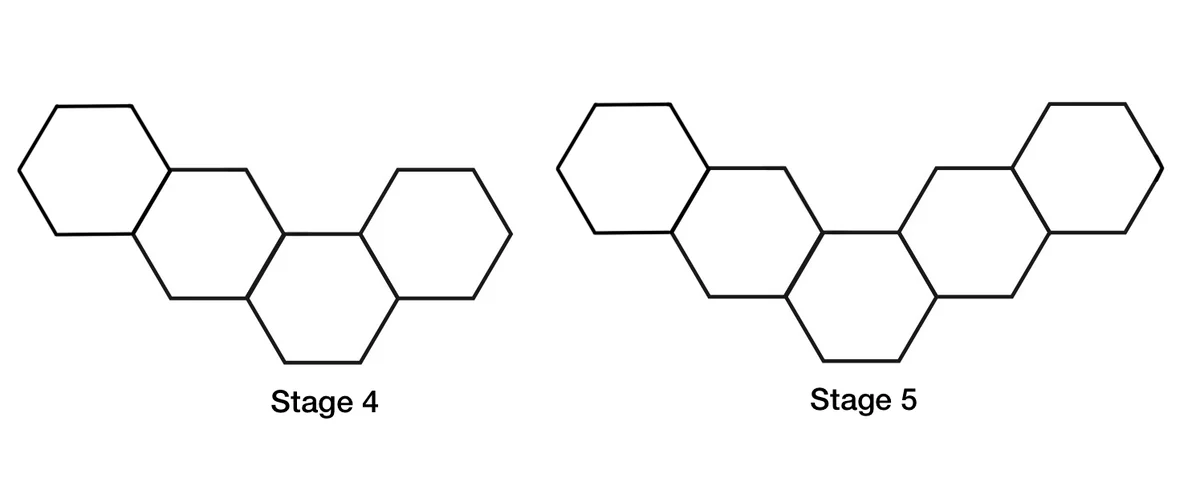
i) Draw the next two stages of the pattern. How many matchsticks will be required at these stages?
SOLUTION
1
Understand the pattern
A single hexagon uses \(6\) matchsticks. Every new hexagon shares \(1\) side with the previous hexagon, so a new hexagon adds only \(6-1 = 5\) matchsticks.
There is an increase of \(5\) matchsticks each stage.
There is an increase of \(5\) matchsticks each stage.
2
Count the number of matchsticks required for the next two stages
Stage 1: \(1\) hexagon requires \(6\) matchsticks.
Stage 2: A second hexagon is added sharing one side with the first. So, \(6+5 = 11\) matchsticks.
Stage 3: For third hexagon, \(11+5 = 16\) matchsticks.
Stage 4: For fourth hexagon, \(16+5 = 21\) matchsticks.
Stage 5: For fifth hexagon, \(21+5 = 26\) matchsticks.
Stage 2: A second hexagon is added sharing one side with the first. So, \(6+5 = 11\) matchsticks.
Stage 3: For third hexagon, \(11+5 = 16\) matchsticks.
Stage 4: For fourth hexagon, \(16+5 = 21\) matchsticks.
Stage 5: For fifth hexagon, \(21+5 = 26\) matchsticks.
3
Draw the next two stages of the pattern
Shown in figure.
Concept Note
The number of matchsticks increases by a fixed amount each stage, so the relationship is linear.