QUESTION 2
Easy
Let us say you have a box containing 3 red pens, 4 black pens, and 2 green pens. You pick a pen(without looking) from the box and put it back. Then your friend does the same.
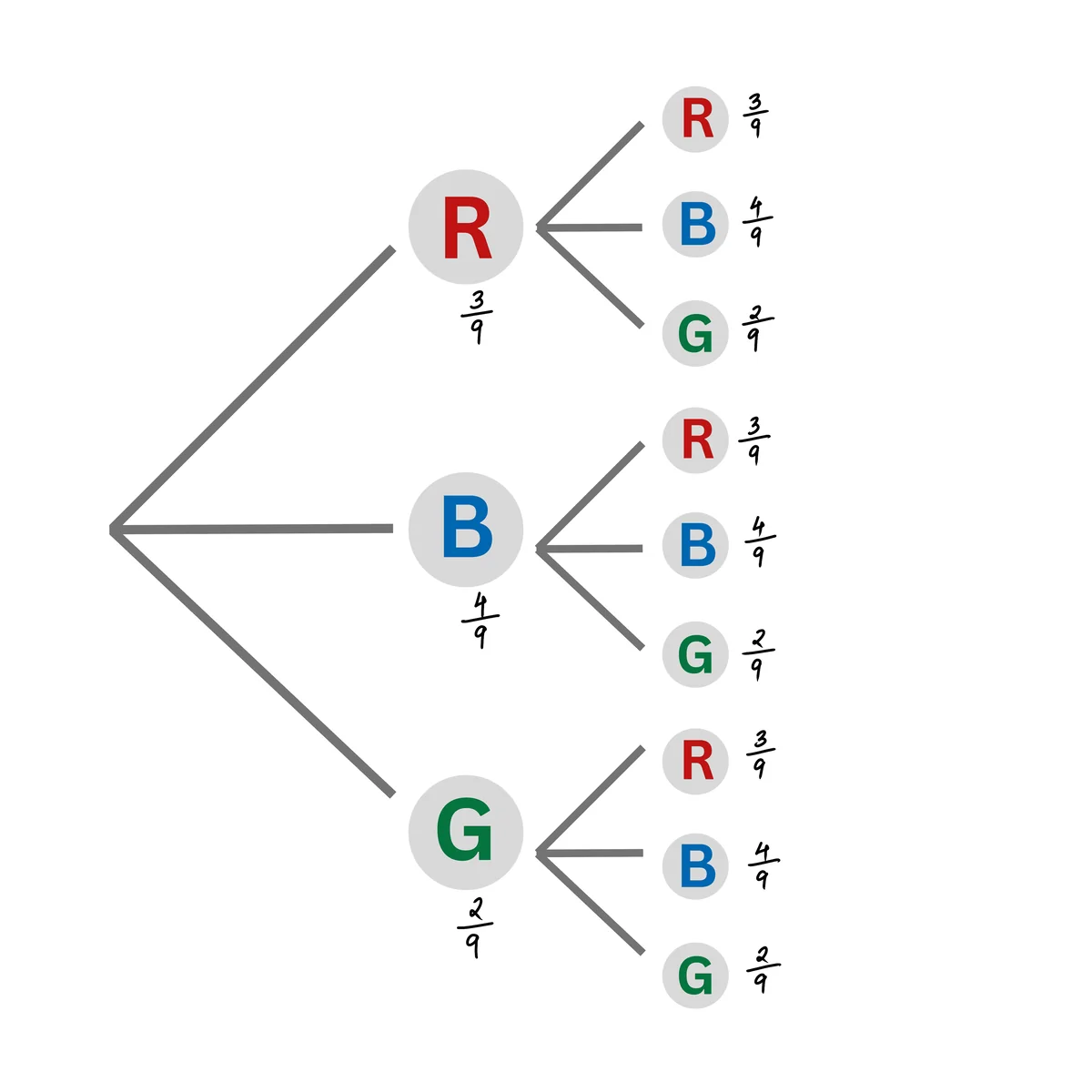
(i) What are the possible outcomes of the pen colours? Can you draw a tree diagram representing the possible outcomes?
(ii) Can you use the tree diagram to guess the probability that both you and your friend pick pens of the same colour?
SOLUTION
1
Note down the given data
A box contains 3 red pens(R), 4 black pens(B), and 2 green pens(G)
Total pens \(= 3 + 4 + 2 = 9\)
You pick a pen and put it back. Then your friend also picks one pen. Since the pen is replaced, the two events are independent.
Total pens \(= 3 + 4 + 2 = 9\)
You pick a pen and put it back. Then your friend also picks one pen. Since the pen is replaced, the two events are independent.
2
(i) Write the possible outcomes of the pen colours and draw the tree diagram
Each person can pick Red(R), Black(B) or Green(G).
So the possible outcomes are:
\(S = \{(R,R),(R,B),(R,G),(B,R),(B,B),(B,G),(G,R),(G,B),(G,G)\}\) Tree diagram shown in figure.
So the possible outcomes are:
\(S = \{(R,R),(R,B),(R,G),(B,R),(B,B),(B,G),(G,R),(G,B),(G,G)\}\) Tree diagram shown in figure.
3
Find probability of finding each colour
\(P(R) = \frac{3}{9} = \frac{1}{3}\)
\(P(B) = \frac{4}{9}\)
\(P(G) = \frac{2}{9}\)
\(P(B) = \frac{4}{9}\)
\(P(G) = \frac{2}{9}\)
4
(ii) Find the probability that both pick the same colour
The same colour outcomes are: \((R,R),(B,B),(G,G)\)
Probability of \((R,R)\):
\(P(R,R) = \frac{1}{3} × \frac{1}{3} = \frac{1}{9}\)
Probability of \((B,B)\):
\(P(B,B) = \frac{4}{9} × \frac{4}{9} = \frac{16}{81}\)
Probability of \((G,G)\):
\(P(G,G) = \frac{2}{9} × \frac{2}{9} = \frac{4}{81}\)
Total Probability, \(P(same\, colour) = \frac{1}{9} + \frac{16}{81} + \frac{4}{81} = \frac{9 + 16 + 4}{81} = \frac{29}{81}\)
So, the probability that both you and your friend pick pens of the same colour is \(\frac{29}{81}\).
Probability of \((R,R)\):
\(P(R,R) = \frac{1}{3} × \frac{1}{3} = \frac{1}{9}\)
Probability of \((B,B)\):
\(P(B,B) = \frac{4}{9} × \frac{4}{9} = \frac{16}{81}\)
Probability of \((G,G)\):
\(P(G,G) = \frac{2}{9} × \frac{2}{9} = \frac{4}{81}\)
Total Probability, \(P(same\, colour) = \frac{1}{9} + \frac{16}{81} + \frac{4}{81} = \frac{9 + 16 + 4}{81} = \frac{29}{81}\)
So, the probability that both you and your friend pick pens of the same colour is \(\frac{29}{81}\).
🏆
Final Answer :
(i) Possible outcomes, S = {(R,R),(R,B),(R,G),(B,R),(B,B),(B,G),(G,R),(G,B),(G,G)}.
(ii) Probability that both pick pens of the same colour = \(\frac{29}{81}\).
Concept Note
The sample space is the set of all possible outcomes of an experiment.
A tree diagram is a visual representation used to list all possible outcomes of a multi-step experiment.
Since the pen is replaced after the first pick, the second pick is not affected by the first. Such events are called independent events.
For independent events,
\(P(A\, and\, B) = P(A) × P(B)\)