QUESTION 13
Easy
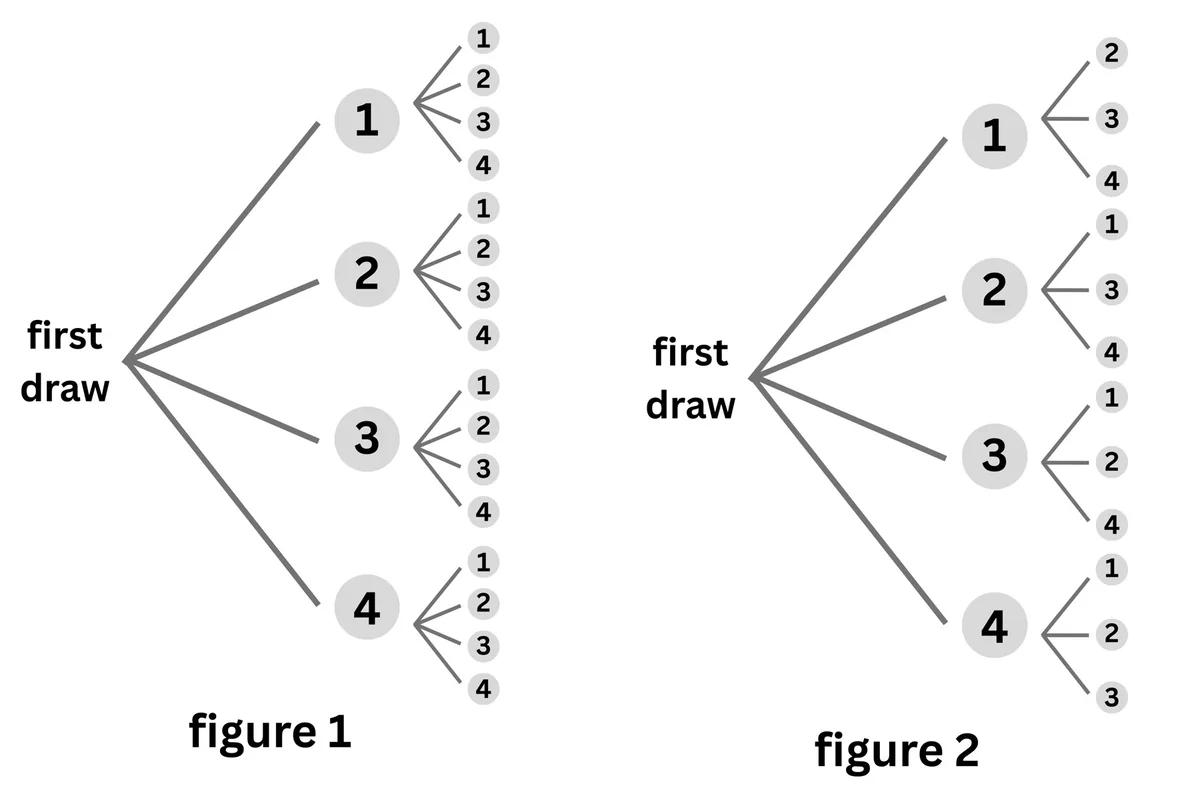
A box contains 4 balls numbered 1 to 4. Record a sample space using a tree diagram for the following experiments:
(i) A ball is drawn, and the number is recorded. Then the ball is returned, and a second ball is drawn and recorded.
(ii) A ball is drawn and recorded. Without replacing the first ball, the experimenter draws and records a second ball.
(iii) What are the sizes of these two sample spaces?
SOLUTION
1
(i) A ball is drawn, replaced, and a second ball is drawn
For first draw, the possible outcomes are:
\(\{1, 2, 3, 4\}\)
Since the ball is returned to the box, the possible outcomes for the second draw will also be:
\(\{1, 2, 3, 4\}\)
The sample space is:
\(S_1 = \{(1,1),(1,2),(1,3),(1,4),(2,1),(2,2),(2,3),(2,4),(3,1),(3,2),(3,3),(3,4),(4,1),(4,2),(4,3),(4,4)\}\) Tree diagram shown in figure 1.
\(\{1, 2, 3, 4\}\)
Since the ball is returned to the box, the possible outcomes for the second draw will also be:
\(\{1, 2, 3, 4\}\)
The sample space is:
\(S_1 = \{(1,1),(1,2),(1,3),(1,4),(2,1),(2,2),(2,3),(2,4),(3,1),(3,2),(3,3),(3,4),(4,1),(4,2),(4,3),(4,4)\}\) Tree diagram shown in figure 1.
2
(ii) A ball is drawn without replacement
For first draw, the possible outcomes are:
\(\{1, 2, 3, 4\}\)
Since the first ball is not replaced, only three balls remain for the second draw.
The sample space is:
\(S_2 = \{(1,2),(1,3),(1,4),(2,1),(2,3),(3,4),(3,1),(3,2),(3,4),(4,1),(4,2),(4,3)\}\)
Tree diagram shown in figure 2.
\(\{1, 2, 3, 4\}\)
Since the first ball is not replaced, only three balls remain for the second draw.
The sample space is:
\(S_2 = \{(1,2),(1,3),(1,4),(2,1),(2,3),(3,4),(3,1),(3,2),(3,4),(4,1),(4,2),(4,3)\}\)
Tree diagram shown in figure 2.
3
(iii) Sizes of the two sample spaces
Size of first sample space, \(n(S_1) = 16\)
Size of second sample space, \(n(S_2) = 12\)
Size of second sample space, \(n(S_2) = 12\)
Concept Note
A sample space is the set of all possible outcomes of an experiment.
In an experiment with replacement, the first drawn item is returned, so the number of choices remain the same.
In an experiment without replacement, the first drawn item is not returned, so there is one less choice available for the second draw.
The size of a sample space is the total number of possible outcomes.