QUESTION 1
Easy
Without performing long division, determine which of the following rational numbers will have terminating decimals and which will be repeating:
\(\frac{7}{20}\), \(\frac{4}{15}\) and \(\frac{13}{250}\).
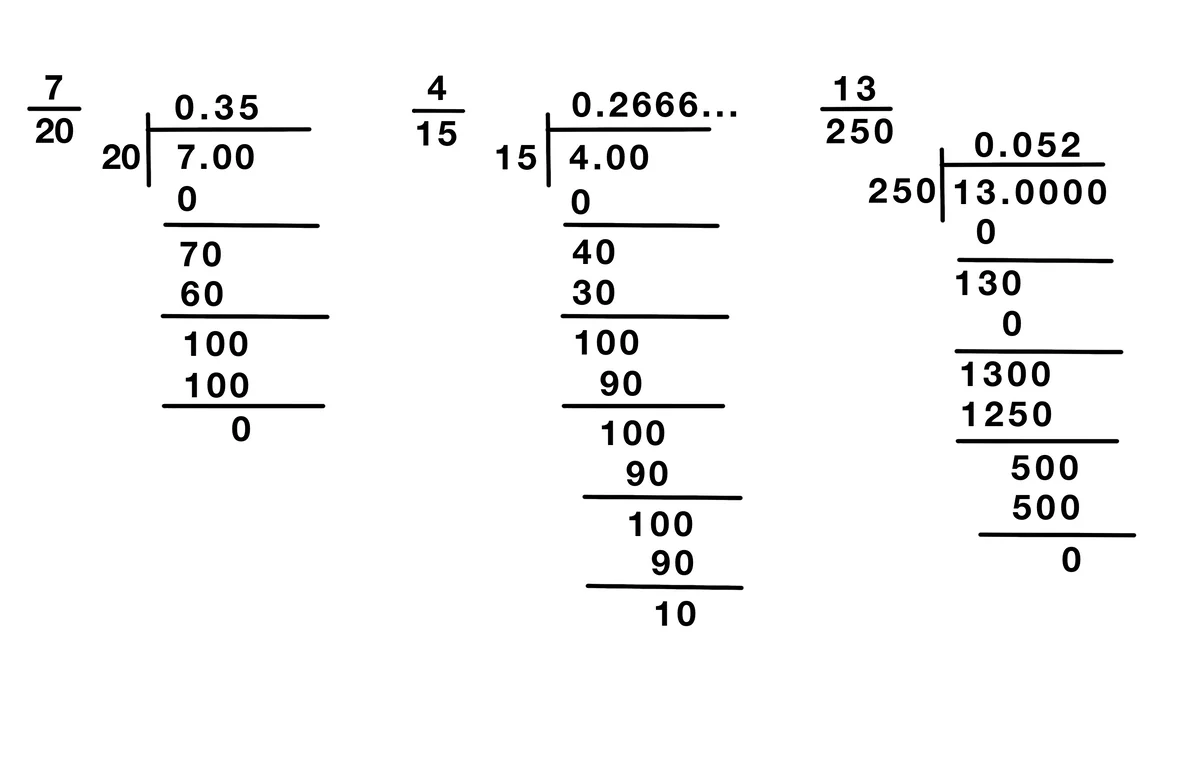
Then check your answers by explicitly performing the long divisions and expressing these rational numbers as decimals.
SOLUTION
A rational number, \(\frac{p}{q}\) (in its simplest form), has a terminating decimal expansion if and only if the denominator \(q\) can be expressed in the form:
\(q = 2^m × 5^n\), where \(m\) and \(n\) are non negative integers
For \(\frac{7}{20}\), prime factorisation of 20:
20 = 2 × 2 × 5 = 2\(^2\) × 5
Since it only contains 2 and 5, it will terminate.
Long division shown in figure.
\(\frac{7}{20} = 0.35\)
Therefore, it terminates.
For \(\frac{4}{15}\), prime factorisation of 15:
15 = 3 × 5
Since it contains a 3 , it will be non-terminating. Long division shown in figure.
\(\frac{4}{15} = 0.2666... 0.2\overline{6} = \)
Therefore, it is a non terminating, repeating expansion.
For \(\frac{13}{250}\), prime factorisation of 250:
250 = 2 × 5 × 5 × 5 = 2 × 5\(^3\)
Since it only contains 2 and 5, it will terminate.
Long division shown in figure.
\(\frac{13}{250} = 0.052\)
Therefore, it terminates.